
32. Punteggio totale e modello fattoriale#
In questo capitolo discute l’uso del punteggio totale del test quale misura del costrutto latente. Questa è una pratica largamente usata, ma solo in parte giustificata. Esamineremo a questo proposito le considerazioni di McNeish e Wolf (2020).
32.1. Punteggio totale e modello fattoriale parallelo#
McNeish e Wolf (2020) richiamano l’attenzione sul fatto che usare il punteggio totale quale misura di un costrutto è possibile solo quando i dati soddisfano i vincoli di un modello fattoriale parallelo.
Consideriamo l’esempio seguente, nel quale McNeish e Wolf (2020) esaminano i dati “classici” di Holzinger and Swineford (1939), i quali si riferiscono ai seguenti item:
Paragraph comprehension
Sentence completion
Word definitions
Speeded addition
Speeded dot counting
Discrimination between curved and straight letters
Leggiamo i dati in R.
d <- rio::import(
  "../data/1_Factor_Parallel.csv"
)
McNeish e Wolf (2020) sottolineano il fatto che il punteggio totale
rappresenta l’idea che ciasun item fornisca la stessa quantità di informazione relativamente alla misura del costrutto. Ciò può essere specificato da un modello fattoriale nel quale le saturazioni fattoriali degli item sono tutte uguali a 1. Questo corrisponde al modello parallelo che abbiamo discusso in precedenza. In tali circostanze, i punteggi fattoriali del test risultano perfettamente associati al punteggio totale (correlazione uguale a 1). Dunque, se tale modello fattoriale è giustificato dai dati, questo giustifica l’uso del punteggio totale del test quale misura del costrutto.
È facile verificare tali affermazioni. Implementiamo il modello parallelo.
m_parallel <-
  "
  # all loadings are fixed to one
  f1 =~ 1*X4 + 1*X5 + 1*X6 + 1*X7 + 1*X8 + 1*X9

  # all residual variances constrained to same value
  X4 ~~ theta*X4
  X5 ~~ theta*X5
  X6 ~~ theta*X6
  X7 ~~ theta*X7
  X8 ~~ theta*X8
  X9 ~~ theta*X9
"
Adattiamo il modello parallelo ai dati forniti dagli autori.
fit_parallel <- sem(m_parallel, data=d)
Calcoliamo il punteggio totale.
d$ts <- with(
  d,
  X4 + X5 + X6 + X7 + X8 + X9
)
Calcoliamo i punteggi fattoriali.
scores <- lavPredict(fit_parallel, method="regression")
d$scores <- as.numeric(scores)
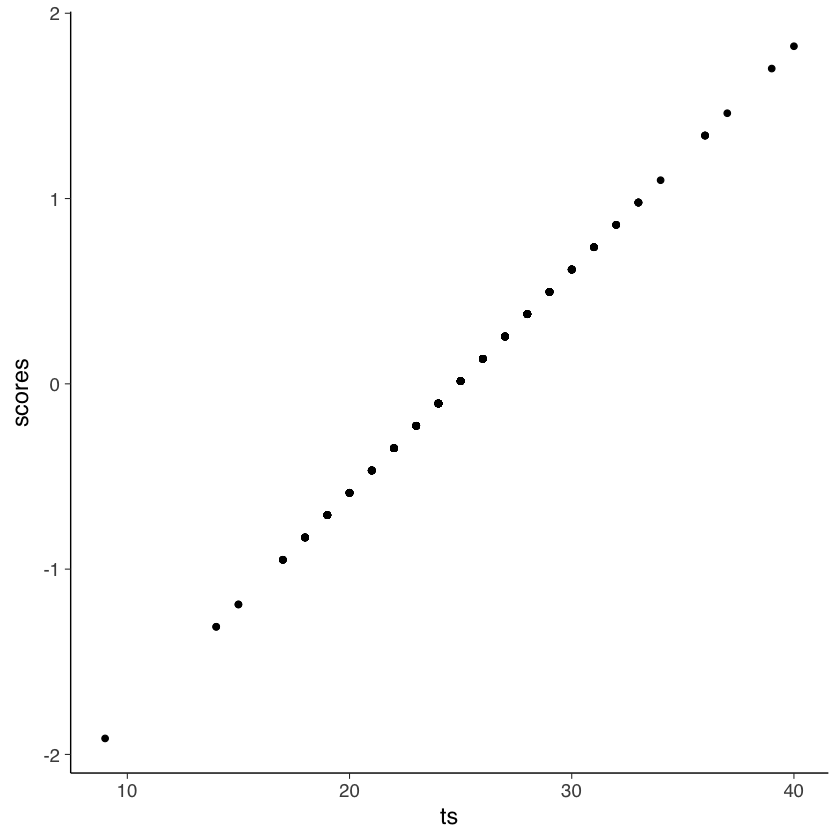
Un diagramma a dispersione tra il punteggio totale e i punteggi fattoriali conferma che i due sono perfettamente associati. Quindi, usare il punteggio totale o i punteggi fattoriali è equivalente.
d |>
  ggplot(aes(x=ts, y=scores)) +
  geom_point()
Tuttavia, questa conclusione è valida solo se il modello parallelo è giustificato per i dati. Se esaminiamo l’output di lavaan vediamo che, nel caso presente, questo non è vero.
# report output with fit measures and standardized estimates
out = summary(fit_parallel, fit.measures = TRUE, standardized = TRUE)
print(out)
lavaan 0.6.17 ended normally after 13 iterations

  Estimator                                         ML
  Optimization method                           NLMINB
  Number of model parameters                         7
  Number of equality constraints                     5

  Number of observations                           301

Model Test User Model:

  Test statistic                               325.899
  Degrees of freedom                                19
  P-value (Chi-square)                           0.000

Model Test Baseline Model:

  Test statistic                               568.519
  Degrees of freedom                                15
  P-value                                        0.000

User Model versus Baseline Model:

  Comparative Fit Index (CFI)                    0.446
  Tucker-Lewis Index (TLI)                       0.562

Loglikelihood and Information Criteria:

  Loglikelihood user model (H0)              -2680.931
  Loglikelihood unrestricted model (H1)      -2517.981

  Akaike (AIC)                                5365.862
  Bayesian (BIC)                              5373.276
  Sample-size adjusted Bayesian (SABIC)       5366.933

Root Mean Square Error of Approximation:

  RMSEA                                          0.232
  90 Percent confidence interval - lower         0.210
  90 Percent confidence interval - upper         0.254
  P-value H_0: RMSEA <= 0.050                    0.000
  P-value H_0: RMSEA >= 0.080                    1.000

Standardized Root Mean Square Residual:

  SRMR                                           0.206

Parameter Estimates:

  Standard errors                             Standard
  Information                                 Expected
  Information saturated (h1) model          Structured

Latent Variables:
                   Estimate  Std.Err  z-value  P(>|z|)   Std.lv  Std.all
  f1 =~
    X4                1.000                               0.633    0.551
    X5                1.000                               0.633    0.551
    X6                1.000                               0.633    0.551
    X7                1.000                               0.633    0.551
    X8                1.000                               0.633    0.551
    X9                1.000                               0.633    0.551

Variances:
                   Estimate  Std.Err  z-value  P(>|z|)   Std.lv  Std.all
   .X4      (thet)    0.920    0.034   27.432    0.000    0.920    0.697
   .X5      (thet)    0.920    0.034   27.432    0.000    0.920    0.697
   .X6      (thet)    0.920    0.034   27.432    0.000    0.920    0.697
   .X7      (thet)    0.920    0.034   27.432    0.000    0.920    0.697
   .X8      (thet)    0.920    0.034   27.432    0.000    0.920    0.697
   .X9      (thet)    0.920    0.034   27.432    0.000    0.920    0.697
    f1                0.400    0.045    8.803    0.000    1.000    1.000
Dunque, per questi dati, il punteggio totale può ovviamente essere calcolato. Ma non fornisce una misura adeguata del costrutto. Dunque, il punteggio totale non dovrebbe essere usato nel caso dei dati ottenuti con questo test.
32.2. Punteggio totale e modello fattoriale congenerico#
Gli autori adattano ai dati un modello congenerico.
m_congeneric <-
'
  #all loadings are uniquely estimated
  f1 =~ NA*X4 + X5 + X6 + X7 + X8 + X9
  #constrain factor variance to 1
  f1 ~~ 1*f1
'
# Fit above model
fit_congeneric <- sem(m_congeneric, data=d)
parameterEstimates(fit_congeneric, standardized = TRUE) %>%
  dplyr::filter(op == "=~") %>%
  dplyr::select(
    "Latent Factor" = lhs,
    Indicator = rhs,
    B = est,
    SE = se,
    Z = z,
    "p-value" = pvalue,
    Beta = std.all
  ) %>%
  knitr::kable(
    digits = 3, booktabs = TRUE, format = "markdown",
    caption = "Factor Loadings"
  )
Table: Factor Loadings

|Latent Factor |Indicator |     B|    SE|      Z| p-value|  Beta|
|:-------------|:---------|-----:|-----:|------:|-------:|-----:|
|f1            |X4        | 0.963| 0.059| 16.274|   0.000| 0.824|
|f1            |X5        | 1.121| 0.067| 16.835|   0.000| 0.846|
|f1            |X6        | 0.894| 0.058| 15.450|   0.000| 0.792|
|f1            |X7        | 0.195| 0.071|  2.767|   0.006| 0.170|
|f1            |X8        | 0.185| 0.063|  2.938|   0.003| 0.180|
|f1            |X9        | 0.278| 0.065|  4.245|   0.000| 0.258|
Si noti che le saturazioni fattoriali sono molto diverse tra loro, suggerendo che il punteggio del costrutto si relaziona in modo diverso con ciascun item e che sarebbe inappropriato stimare il punteggio del costrutto assegnando un peso unitario agli item.
McNeish e Wolf (2020) calcolano poi i punteggi fattoriali del modello congenerico.
scores_cong <- lavPredict(fit_congeneric, method="regression")
d$scores_cong <- as.numeric(scores_cong)
Il grafico seguente mostra la relazione tra i punteggi fattoriali e il punteggio totale.
d |>
  ggplot(aes(x=ts, y=scores_cong)) +
  geom_point()
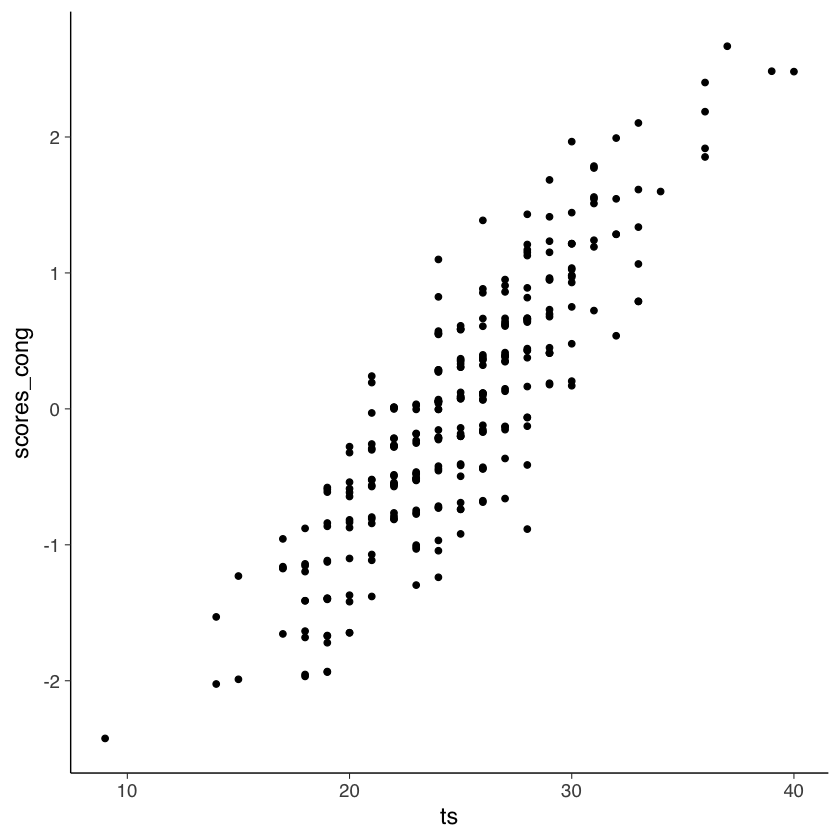
Nel caso presente, il coefficiente di determinazione tra punteggio totale e punteggi fattoriali è 0.77.
cor(d$ts, d$scores_cong)^2
Secondo gli autori, ciò significa che due persone con un punteggio totale identico potrebbero avere punteggi di modello congenerico potenzialmente diversi perché hanno raggiunto il loro particolare punteggio totale approvando item diversi. Poiché il modello congenerico assegna pesi diversi agli item, ciascun item contribuisce in modo diverso al punteggio fattoriale del modello congenerico, il che non è vero per il punteggio totale.
Si noti che, per i dati di Holzinger and Swineford (1939), neppure un modello congenerico ad un fattore si dimostra adeguato.
out = summary(fit_congeneric, fit.measures = TRUE, standardized = TRUE)
print(out)
lavaan 0.6.17 ended normally after 16 iterations

  Estimator                                         ML
  Optimization method                           NLMINB
  Number of model parameters                        12

  Number of observations                           301

Model Test User Model:

  Test statistic                               115.366
  Degrees of freedom                                 9
  P-value (Chi-square)                           0.000

Model Test Baseline Model:

  Test statistic                               568.519
  Degrees of freedom                                15
  P-value                                        0.000

User Model versus Baseline Model:

  Comparative Fit Index (CFI)                    0.808
  Tucker-Lewis Index (TLI)                       0.680

Loglikelihood and Information Criteria:

  Loglikelihood user model (H0)              -2575.664
  Loglikelihood unrestricted model (H1)      -2517.981

  Akaike (AIC)                                5175.328
  Bayesian (BIC)                              5219.813
  Sample-size adjusted Bayesian (SABIC)       5181.756

Root Mean Square Error of Approximation:

  RMSEA                                          0.198
  90 Percent confidence interval - lower         0.167
  90 Percent confidence interval - upper         0.231
  P-value H_0: RMSEA <= 0.050                    0.000
  P-value H_0: RMSEA >= 0.080                    1.000

Standardized Root Mean Square Residual:

  SRMR                                           0.129

Parameter Estimates:

  Standard errors                             Standard
  Information                                 Expected
  Information saturated (h1) model          Structured

Latent Variables:
                   Estimate  Std.Err  z-value  P(>|z|)   Std.lv  Std.all
  f1 =~
    X4                0.963    0.059   16.274    0.000    0.963    0.824
    X5                1.121    0.067   16.835    0.000    1.121    0.846
    X6                0.894    0.058   15.450    0.000    0.894    0.792
    X7                0.195    0.071    2.767    0.006    0.195    0.170
    X8                0.185    0.063    2.938    0.003    0.185    0.180
    X9                0.278    0.065    4.245    0.000    0.278    0.258

Variances:
                   Estimate  Std.Err  z-value  P(>|z|)   Std.lv  Std.all
    f1                1.000                               1.000    1.000
   .X4                0.437    0.056    7.775    0.000    0.437    0.320
   .X5                0.500    0.071    6.998    0.000    0.500    0.285
   .X6                0.474    0.054    8.777    0.000    0.474    0.372
   .X7                1.278    0.105   12.211    0.000    1.278    0.971
   .X8                1.023    0.084   12.204    0.000    1.023    0.967
   .X9                1.080    0.089   12.132    0.000    1.080    0.933
Se trascuriamo le considerazioni sulla struttura fattoriale e esaminiamo (per esempio) unicamente il coefficiente omega, finiamo per trovare una risposta accettabile, ma sbagliata.
psych::omega(d[, 1:6])
Loading required namespace: GPArotation
Omega
Call: omegah(m = m, nfactors = nfactors, fm = fm, key = key, flip = flip,
    digits = digits, title = title, sl = sl, labels = labels,
    plot = plot, n.obs = n.obs, rotate = rotate, Phi = Phi, option = option,
    covar = covar)
Alpha:                 0.72
G.6:                   0.76
Omega Hierarchical:    0.55
Omega H asymptotic:    0.65
Omega Total            0.84

Schmid Leiman Factor loadings greater than  0.2
      g  F1*  F2*   F3*   h2   u2   p2
X4 0.73            0.68 1.00 0.00 0.53
X5 0.96                 0.92 0.08 1.00
X6 0.69            0.22 0.54 0.46 0.90
X7           0.56       0.33 0.67 0.03
X8           0.75       0.59 0.41 0.05
X9 0.22      0.49       0.29 0.71 0.16

With Sums of squares  of:
   g  F1*  F2*  F3*
2.02 0.00 1.11 0.54

general/max  1.82   max/min =   257.39
mean percent general =  0.44    with sd =  0.43 and cv of  0.97
Explained Common Variance of the general factor =  0.55

The degrees of freedom are 0  and the fit is  0
The number of observations was  301  with Chi Square =  0.03  with prob <  NA
The root mean square of the residuals is  0
The df corrected root mean square of the residuals is  NA

Compare this with the adequacy of just a general factor and no group factors
The degrees of freedom for just the general factor are 9  and the fit is  0.48
The number of observations was  301  with Chi Square =  142.26  with prob <  3.5e-26
The root mean square of the residuals is  0.17
The df corrected root mean square of the residuals is  0.21

RMSEA index =  0.222  and the 10 % confidence intervals are  0.191 0.255
BIC =  90.9

Measures of factor score adequacy
                                                 g   F1*  F2*  F3*
Correlation of scores with factors            0.96  0.08 0.83 0.96
Multiple R square of scores with factors      0.93  0.01 0.68 0.91
Minimum correlation of factor score estimates 0.86 -0.99 0.36 0.83

 Total, General and Subset omega for each subset
                                                 g  F1*  F2*  F3*
Omega total for total scores and subscales    0.84 0.92 0.66 0.86
Omega general for total scores and subscales  0.55 0.92 0.04 0.61
Omega group for total scores and subscales    0.27 0.00 0.61 0.25

È invece necessario ipotizzare un modello congenerico a due fattori.
m2f_cong <- '
  # all loadings are uniquely estimated on each factor
  f1 =~ NA*X4 + X5 + X6
  f2 =~ NA*X7 + X8 + X9

  # constrain factor variancse to 1
  f1 ~~ 1*f1
  f2 ~~ 1*f2

  # estimate factor covariance
  f1 ~~ f2
'
# Fit above model
fit_2f_congeneric <- sem(m2f_cong, data=d)
Solo questo modello fornisce un adattamento adeguato ai dati.
out = summary(fit_2f_congeneric, fit.measures = TRUE, standardized = TRUE)
print(out)
lavaan 0.6.17 ended normally after 18 iterations

  Estimator                                         ML
  Optimization method                           NLMINB
  Number of model parameters                        13

  Number of observations                           301

Model Test User Model:

  Test statistic                                14.736
  Degrees of freedom                                 8
  P-value (Chi-square)                           0.064

Model Test Baseline Model:

  Test statistic                               568.519
  Degrees of freedom                                15
  P-value                                        0.000

User Model versus Baseline Model:

  Comparative Fit Index (CFI)                    0.988
  Tucker-Lewis Index (TLI)                       0.977

Loglikelihood and Information Criteria:

  Loglikelihood user model (H0)              -2525.349
  Loglikelihood unrestricted model (H1)      -2517.981

  Akaike (AIC)                                5076.698
  Bayesian (BIC)                              5124.891
  Sample-size adjusted Bayesian (SABIC)       5083.662

Root Mean Square Error of Approximation:

  RMSEA                                          0.053
  90 Percent confidence interval - lower         0.000
  90 Percent confidence interval - upper         0.095
  P-value H_0: RMSEA <= 0.050                    0.402
  P-value H_0: RMSEA >= 0.080                    0.159

Standardized Root Mean Square Residual:

  SRMR                                           0.035

Parameter Estimates:

  Standard errors                             Standard
  Information                                 Expected
  Information saturated (h1) model          Structured

Latent Variables:
                   Estimate  Std.Err  z-value  P(>|z|)   Std.lv  Std.all
  f1 =~
    X4                0.965    0.059   16.296    0.000    0.965    0.826
    X5                1.123    0.067   16.845    0.000    1.123    0.847
    X6                0.895    0.058   15.465    0.000    0.895    0.793
  f2 =~
    X7                0.659    0.080    8.218    0.000    0.659    0.575
    X8                0.733    0.077    9.532    0.000    0.733    0.712
    X9                0.599    0.075    8.025    0.000    0.599    0.557

Covariances:
                   Estimate  Std.Err  z-value  P(>|z|)   Std.lv  Std.all
  f1 ~~
    f2                0.275    0.072    3.813    0.000    0.275    0.275

Variances:
                   Estimate  Std.Err  z-value  P(>|z|)   Std.lv  Std.all
    f1                1.000                               1.000    1.000
    f2                1.000                               1.000    1.000
   .X4                0.433    0.056    7.679    0.000    0.433    0.318
   .X5                0.496    0.072    6.892    0.000    0.496    0.282
   .X6                0.472    0.054    8.732    0.000    0.472    0.371
   .X7                0.881    0.100    8.807    0.000    0.881    0.670
   .X8                0.521    0.094    5.534    0.000    0.521    0.492
   .X9                0.798    0.087    9.162    0.000    0.798    0.689
Nel contesto di questi dati, l’utilizzo di un modello congenerico non è sufficiente a giustificare l’impiego del punteggio totale, che rappresenta la somma dei punteggi degli item. Questo perché, nel caso specifico, sommando i punteggi di tutti gli item, finiremmo per includere misurazioni di due costrutti distinti.
32.3. Session Info#
sessionInfo()
R version 4.3.3 (2024-02-29)
Platform: x86_64-apple-darwin20 (64-bit)
Running under: macOS Sonoma 14.4.1

Matrix products: default
BLAS:   /Library/Frameworks/R.framework/Versions/4.3-x86_64/Resources/lib/libRblas.0.dylib
LAPACK: /Library/Frameworks/R.framework/Versions/4.3-x86_64/Resources/lib/libRlapack.dylib;  LAPACK version 3.11.0

locale:
[1] en_US.UTF-8/UTF-8/en_US.UTF-8/C/en_US.UTF-8/en_US.UTF-8

time zone: Europe/Rome
tzcode source: internal

attached base packages:
[1] stats     graphics  grDevices utils     datasets  methods   base

other attached packages:
 [1] modelsummary_1.4.5 ggokabeito_0.1.0   viridis_0.6.5      viridisLite_0.4.2
 [5] ggpubr_0.6.0       ggExtra_0.10.1     bayesplot_1.11.1   gridExtra_2.3
 [9] patchwork_1.2.0    semTools_0.5-6.920 semPlot_1.1.6      lavaan_0.6-17
[13] psych_2.4.3        scales_1.3.0       markdown_1.12      knitr_1.45
[17] lubridate_1.9.3    forcats_1.0.0      stringr_1.5.1      dplyr_1.1.4
[21] purrr_1.0.2        readr_2.1.5        tidyr_1.3.1        tibble_3.2.1
[25] ggplot2_3.5.1      tidyverse_2.0.0    here_1.0.1

loaded via a namespace (and not attached):
  [1] rstudioapi_0.16.0    jsonlite_1.8.8       magrittr_2.0.3
  [4] TH.data_1.1-2        estimability_1.5     farver_2.1.1
  [7] nloptr_2.0.3         rmarkdown_2.26       vctrs_0.6.5
 [10] minqa_1.2.6          base64enc_0.1-3      rstatix_0.7.2
 [13] htmltools_0.5.8.1    broom_1.0.5          Formula_1.2-5
 [16] htmlwidgets_1.6.4    plyr_1.8.9           sandwich_3.1-0
 [19] rio_1.0.1            emmeans_1.10.0       zoo_1.8-12
 [22] uuid_1.2-0           igraph_2.0.3         mime_0.12
 [25] lifecycle_1.0.4      pkgconfig_2.0.3      Matrix_1.6-5
 [28] R6_2.5.1             fastmap_1.1.1        shiny_1.8.1.1
 [31] digest_0.6.35        OpenMx_2.21.11       fdrtool_1.2.17
 [34] colorspace_2.1-0     rprojroot_2.0.4      Hmisc_5.1-2
 [37] labeling_0.4.3       fansi_1.0.6          timechange_0.3.0
 [40] abind_1.4-5          compiler_4.3.3       withr_3.0.0
 [43] glasso_1.11          htmlTable_2.4.2      backports_1.4.1
 [46] carData_3.0-5        R.utils_2.12.3       ggsignif_0.6.4
 [49] MASS_7.3-60.0.1      GPArotation_2024.3-1 corpcor_1.6.10
 [52] gtools_3.9.5         tools_4.3.3          pbivnorm_0.6.0
 [55] foreign_0.8-86       zip_2.3.1            httpuv_1.6.15
 [58] nnet_7.3-19          R.oo_1.26.0          glue_1.7.0
 [61] quadprog_1.5-8       nlme_3.1-164         promises_1.3.0
 [64] lisrelToR_0.3        grid_4.3.3           pbdZMQ_0.3-11
 [67] checkmate_2.3.1      cluster_2.1.6        reshape2_1.4.4
 [70] generics_0.1.3       gtable_0.3.5         tzdb_0.4.0
 [73] R.methodsS3_1.8.2    data.table_1.15.4    hms_1.1.3
 [76] car_3.1-2            utf8_1.2.4           tables_0.9.17
 [79] sem_3.1-15           pillar_1.9.0         IRdisplay_1.1
 [82] rockchalk_1.8.157    later_1.3.2          splines_4.3.3
 [85] lattice_0.22-6       survival_3.5-8       kutils_1.73
 [88] tidyselect_1.2.1     miniUI_0.1.1.1       pbapply_1.7-2
 [91] stats4_4.3.3         xfun_0.43            qgraph_1.9.8
 [94] arm_1.13-1           stringi_1.8.3        boot_1.3-30
 [97] evaluate_0.23        codetools_0.2-19     mi_1.1
[100] cli_3.6.2            RcppParallel_5.1.7   IRkernel_1.3.2
[103] rpart_4.1.23         xtable_1.8-4         repr_1.1.6
[106] munsell_0.5.1        Rcpp_1.0.12          coda_0.19-4.1
[109] png_0.1-8            XML_3.99-0.16.1      parallel_4.3.3
[112] jpeg_0.1-10          lme4_1.1-35.3        mvtnorm_1.2-4
[115] insight_0.19.9       openxlsx_4.2.5.2     crayon_1.5.2
[118] rlang_1.1.3          multcomp_1.4-25      mnormt_2.1.1